Employer Branding in Sri Lanka: Evolution of Social Media and Embracing the Role of Team
Role of Team Member Employer branding is not just about being an employer; it’s about being a partner, a mentor,


Role of Team Member Employer branding is not just about being an employer; it’s about being a partner, a mentor,

“HR is more than a department; it is a fundamental pillar of business operations.” In the realm of business operations,

SLTC Research University (Sri Lanka Technology Campus) has taken a significant step towards enhancing student career prospects by partnering with

In today’s dynamic work environment, effective HR management requires more than traditional practices—it demands strategic foresight, innovative thinking, and a

Being an HR leader isn’t just about managing employees; it’s about fostering business growth and innovation. Manoj Rathnayake, the Group

In today’s rapidly evolving business landscape, the essence of effective leadership extends beyond traditional metrics of success. Leaders are no


Salary and income insights from Sri Lanka’s Labour Force Survey – Annual Report 2024 reveal important trends in pay levels across gender, industry, geography, and employment type. For HR professionals, these figures offer critical guidance for compensation planning, talent attraction, and equitable pay practices.
In 2024, the mean monthly salary of male employees was Rs. 63,000, while female employees earned an average of Rs. 51,728. Among daily wage earners, the gap is even wider, with female earnings substantially lower than those of males.
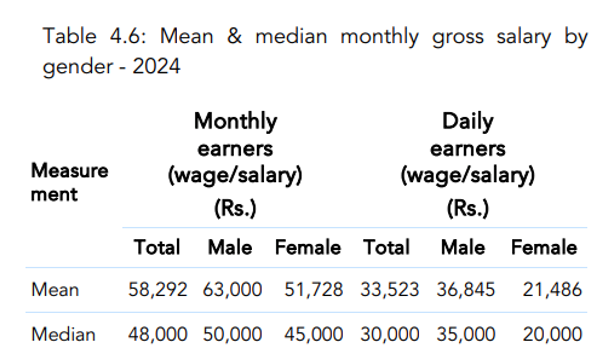
Although median salaries show a narrower difference, the overall data confirms that gender-based pay disparities remain embedded in Sri Lanka’s labour market. HR leaders must continue to prioritise pay equity audits, transparent salary bands, and inclusive career progression frameworks.
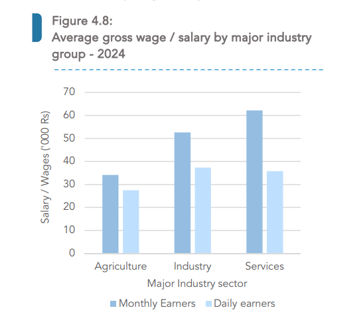
Average salaries vary significantly by industry. In 2024, the services sector recorded the highest mean monthly salary at Rs. 62,176, followed by the industry sector at Rs. 52,581. The agriculture sector remained the lowest at Rs. 34,150.
These figures explain the continued shift of skilled talent towards service-oriented roles such as IT, finance, logistics, and professional services. Employers in lower-paying sectors may need to strengthen non-monetary benefits and career development pathways to remain competitive.
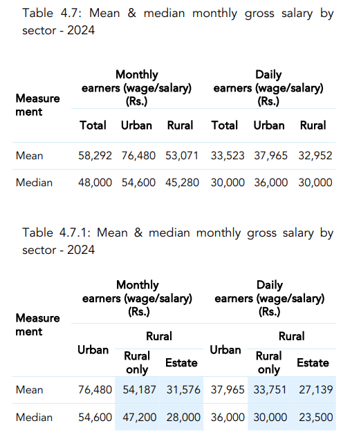
Geographical differences in income are stark. Urban workers reported a mean monthly income of Rs. 85,593, more than double that of rural workers at Rs. 39,857. The estate sector recorded a similar average of Rs. 37,993.
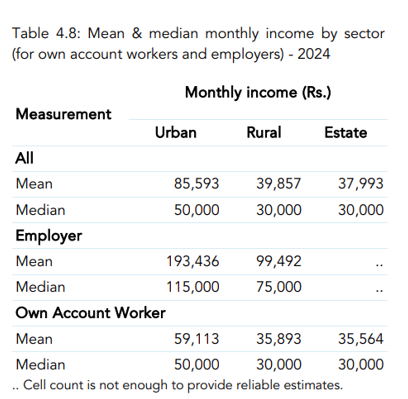
Median income figures follow the same pattern, highlighting structural inequality rather than isolated high earners. HR teams managing islandwide operations must consider location-based compensation and cost-of-living adjustments.
Income data also shows clear differences based on employment type. Employers recorded a mean monthly income exceeding Rs. 193,000, while own-account workers averaged around Rs. 59,000. This gap underscores the financial divide between business ownership and self-employment, particularly outside urban centres.
At a district level, Colombo records the highest mean monthly salary, followed by Gampaha and Kalutara, reflecting the concentration of high-value employment in and around the Western Province. Several districts in the Northern and Central regions continue to report significantly lower average earnings.
The 2024 salary data highlights key priorities for HR leaders: closing gender and regional pay gaps, aligning compensation with sector-specific skill demand, and designing fair, transparent, and data-led salary structures.
Department of Census and Statistics (DCS), Sri Lanka – Labour Force Survey: Annual Report 2024 (Tables 4.6, 4.7, 4.8, 4.9)


