Employer Branding in Sri Lanka: Evolution of Social Media and Embracing the Role of Team
Role of Team Member Employer branding is not just about being an employer; it’s about being a partner, a mentor,


Role of Team Member Employer branding is not just about being an employer; it’s about being a partner, a mentor,

“HR is more than a department; it is a fundamental pillar of business operations.” In the realm of business operations,

SLTC Research University (Sri Lanka Technology Campus) has taken a significant step towards enhancing student career prospects by partnering with

In today’s dynamic work environment, effective HR management requires more than traditional practices—it demands strategic foresight, innovative thinking, and a

Being an HR leader isn’t just about managing employees; it’s about fostering business growth and innovation. Manoj Rathnayake, the Group

In today’s rapidly evolving business landscape, the essence of effective leadership extends beyond traditional metrics of success. Leaders are no

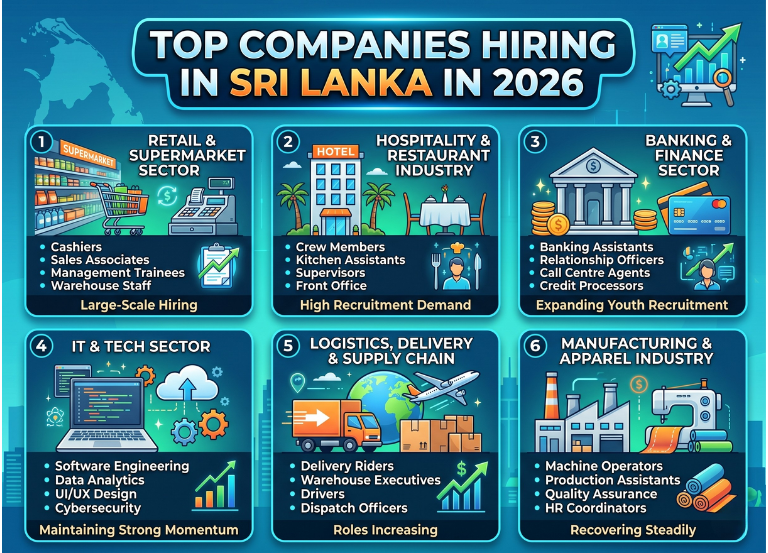
The Sri Lankan job market continues to evolve rapidly in 2026, with companies across retail, banking, hospitality, IT, logistics, manufacturing, and BPO sectors actively expanding their workforce. As businesses adapt to changing consumer trends, digital transformation, and post-economic recovery growth, employers are increasingly looking for skilled, adaptable, and customer-focused talent.
For job seekers, this presents a valuable opportunity to explore industries that are aggressively recruiting and investing in talent development.
Here are some of the top companies and sectors currently driving recruitment demand in Sri Lanka.
Sri Lanka’s retail industry remains one of the biggest employment generators in the country. Supermarket chains, fashion retailers, and FMCG companies are consistently recruiting for operational and customer-facing roles.
Companies in this sector are actively hiring:
Major retail employers continue to expand islandwide operations, creating opportunities for school leavers, part-time workers, and experienced retail professionals alike.
The sector is also increasingly adopting digital recruitment methods such as walk-in campaigns, CV-less applications, and AI-powered screening tools to speed up hiring.
Hotels, cafés, restaurants, and quick-service restaurant chains are experiencing one of the highest hiring demands seen in recent years.
Positions currently in demand include:
One notable trend in 2026 is the increasing preference for flexible shift-based hiring models due to workforce shortages and changing employee expectations.
Many hospitality employers are also opening opportunities for:
Sri Lanka’s banking and finance sector continues to recruit heavily for customer engagement and digital banking operations.
Popular roles include:
Many financial institutions are now focusing on recruiting digitally savvy young professionals who are comfortable working in fast-paced customer environments.
Graduate trainee programs and internship pathways are also seeing increased popularity among undergraduates and fresh graduates.
Despite global economic fluctuations, Sri Lanka’s technology sector remains resilient and continues to create high-paying employment opportunities.
Top hiring areas include:
Companies are increasingly searching for professionals with practical skills, adaptability, and experience with emerging technologies such as AI-assisted development and automation tools.
Remote and hybrid work models continue to attract younger talent into the sector.
The rise of e-commerce and islandwide distribution networks has created strong demand for logistics and supply chain professionals.
Recruitment demand is growing for:
Employers are prioritising reliability, attendance, and operational efficiency as competition within the logistics sector intensifies.
Sri Lanka’s manufacturing and apparel sectors continue to remain major contributors to national employment.
Companies are hiring for:
Many organisations are now improving employee welfare initiatives, transport facilities, and shift flexibility to attract and retain talent.
One of the biggest shifts in Sri Lanka’s recruitment market is the move away from traditional CV-only hiring models.
Employers are increasingly prioritising:
This has opened doors for:
Platforms offering simplified application methods and mobile-friendly recruitment experiences are seeing increased engagement from younger audiences.
Recruitment technology is becoming a major competitive advantage for employers in Sri Lanka.
Companies are increasingly adopting:
These tools help employers hire faster while improving candidate experience and reducing recruitment costs.
As competition for talent increases, organisations investing in smarter recruitment technology are expected to gain a significant advantage in attracting quality candidates.
Sri Lanka’s employment market in 2026 shows strong signs of recovery, transformation, and digital evolution. While industries continue to face workforce challenges and talent shortages, opportunities for job seekers are steadily expanding across multiple sectors.
For employers, the focus is no longer just about filling vacancies; it is about building stronger employer brands, improving candidate experiences, and adapting to the expectations of a new generation workforce.
For job seekers, staying adaptable, digitally connected, and skills-focused will remain key to succeeding in the evolving world of work.
As hiring trends continue to shift, companies that innovate their recruitment strategies will likely emerge as the strongest employers in Sri Lanka’s next phase of growth.


