Employer Branding in Sri Lanka: Evolution of Social Media and Embracing the Role of Team
Role of Team Member Employer branding is not just about being an employer; it’s about being a partner, a mentor,


Role of Team Member Employer branding is not just about being an employer; it’s about being a partner, a mentor,

“HR is more than a department; it is a fundamental pillar of business operations.” In the realm of business operations,

SLTC Research University (Sri Lanka Technology Campus) has taken a significant step towards enhancing student career prospects by partnering with

In today’s dynamic work environment, effective HR management requires more than traditional practices—it demands strategic foresight, innovative thinking, and a

Being an HR leader isn’t just about managing employees; it’s about fostering business growth and innovation. Manoj Rathnayake, the Group

In today’s rapidly evolving business landscape, the essence of effective leadership extends beyond traditional metrics of success. Leaders are no


Sri Lanka’s latest official statistics from the Department of Census & Statistics (DCS) provide critical insights into population structure, employment trends, unemployment patterns, and the country’s ongoing economic recovery. For HR professionals, these figures are not merely descriptive — they offer direction for recruitment strategy, workforce planning, and policy formulation.
According to the Census of Population and Housing 2024 published by the Department of Census & Statistics, Sri Lanka’s total population is reported as 21.78 million. Females constitute 51.7% of the population, while males account for 48.3% (DCS, Census of Population and Housing 2024). This demographic composition becomes especially significant when analysed alongside labour force participation data.

Data from the Sri Lanka Labour Force Survey (Annual Reports, 2017–2024) highlights a persistent gender gap in unemployment. Female unemployment has remained consistently higher than male unemployment throughout the period. In 2024, female unemployment stood at 7.1%, compared to 3.0% for males (DCS, Sri Lanka Labour Force Survey – Annual Report 2024). This trend points to structural barriers limiting women’s access to stable employment.

The employment status distribution further illustrates gender-based disparities. Among employed females, 41% are employed in the private sector and 21% in the public sector, while 12% work as unpaid family workers. Only 1% of employed females are classified as employers. In contrast, 46% of employed males work in the private sector, 37% are own-account workers, and 4% are employers (DCS, Sri Lanka Labour Force Survey – Annual Report 2024).
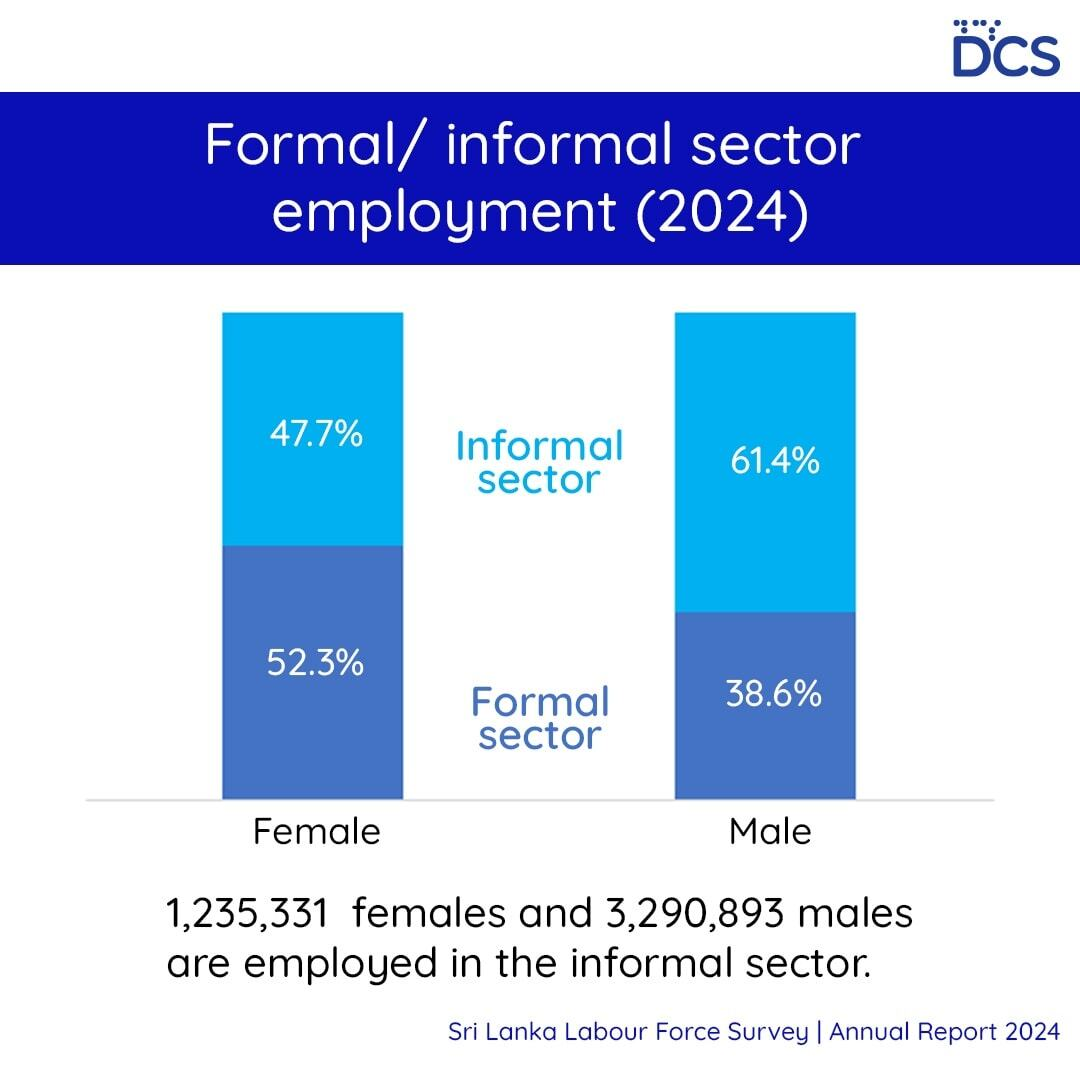
The informal sector continues to play a significant role in Sri Lanka’s labour market. In 2024, 47.7% of employed females and 61.4% of employed males were engaged in informal employment. In absolute terms, approximately 1.23 million females and 3.29 million males were employed in the informal sector (DCS, Sri Lanka Labour Force Survey – Annual Report 2024). These figures highlight the scale of informal work and the importance of formalisation initiatives.
A notable concern for HR professionals is the high proportion of unemployed individuals with advanced educational qualifications. More than 54% of unemployed females possessed G.C.E. A/L, H.N.C.E., or higher qualifications in 2024. Among males, this figure increased to 37.8% in the same year (DCS, Sri Lanka Labour Force Survey – Annual Report 2024). This suggests a growing mismatch between education outcomes and labour market demand.

Economic indicators show signs of recovery. The year-on-year GDP growth rate for the third quarter of 2025 was reported at 5.4%, based on the 2015 base year. Sector-wise growth was led by Industry at 8.1%, followed by Agriculture at 3.6% and Services at 3.5% (Department of Census & Statistics, Quarterly National Accounts, Q3 2025).
The data indicates that Sri Lanka possesses a sizeable and educated labour force, yet structural challenges persist – particularly in relation to female employment, informal work, and skills alignment. HR leaders have a critical role to play in promoting inclusive hiring practices, strengthening school-to-work transitions, supporting formal employment growth, and aligning talent strategies with the country’s economic recovery trajectory.
Department of Census & Statistics (DCS). Census of Population and Housing 2024. Colombo: DCS.
Department of Census & Statistics (DCS). Sri Lanka Labour Force Survey – Annual Report 2024. Colombo: DCS.
Department of Census & Statistics (DCS). Sri Lanka Labour Force Survey – Annual Reports (2017–2023). Colombo: DCS.
Department of Census & Statistics (DCS). Quarterly National Accounts, Third Quarter 2025 (Base Year 2015). Colombo: DCS.
Official website: www.statistics.gov.lk


