Employer Branding in Sri Lanka: Evolution of Social Media and Embracing the Role of Team
Role of Team Member Employer branding is not just about being an employer; it’s about being a partner, a mentor,


Role of Team Member Employer branding is not just about being an employer; it’s about being a partner, a mentor,

“HR is more than a department; it is a fundamental pillar of business operations.” In the realm of business operations,

SLTC Research University (Sri Lanka Technology Campus) has taken a significant step towards enhancing student career prospects by partnering with

In today’s dynamic work environment, effective HR management requires more than traditional practices—it demands strategic foresight, innovative thinking, and a

Being an HR leader isn’t just about managing employees; it’s about fostering business growth and innovation. Manoj Rathnayake, the Group

In today’s rapidly evolving business landscape, the essence of effective leadership extends beyond traditional metrics of success. Leaders are no


Sri Lanka’s labour force statistics over recent years reveal more than just numbers—they reflect deep structural shifts that are shaping the future of work, talent availability, and workforce strategy. For HR professionals and business leaders, understanding these trends is essential to navigating recruitment, retention, and skills planning in a changing economic environment.
Sri Lanka’s overall labour force participation rate has steadily declined from 54.1% in 2017 to 47.4% in 2024. This downward trend is visible across both genders, with male participation decreasing from 74.5% to 67.4%, and female participation falling more sharply from 36.6% to 29.8% during the same period.
From an HR perspective, this signals a tightening labour market and a shrinking active workforce. Low female participation highlights the growing importance of flexible work models, return-to-work programmes, childcare support, and inclusive workplace policies.
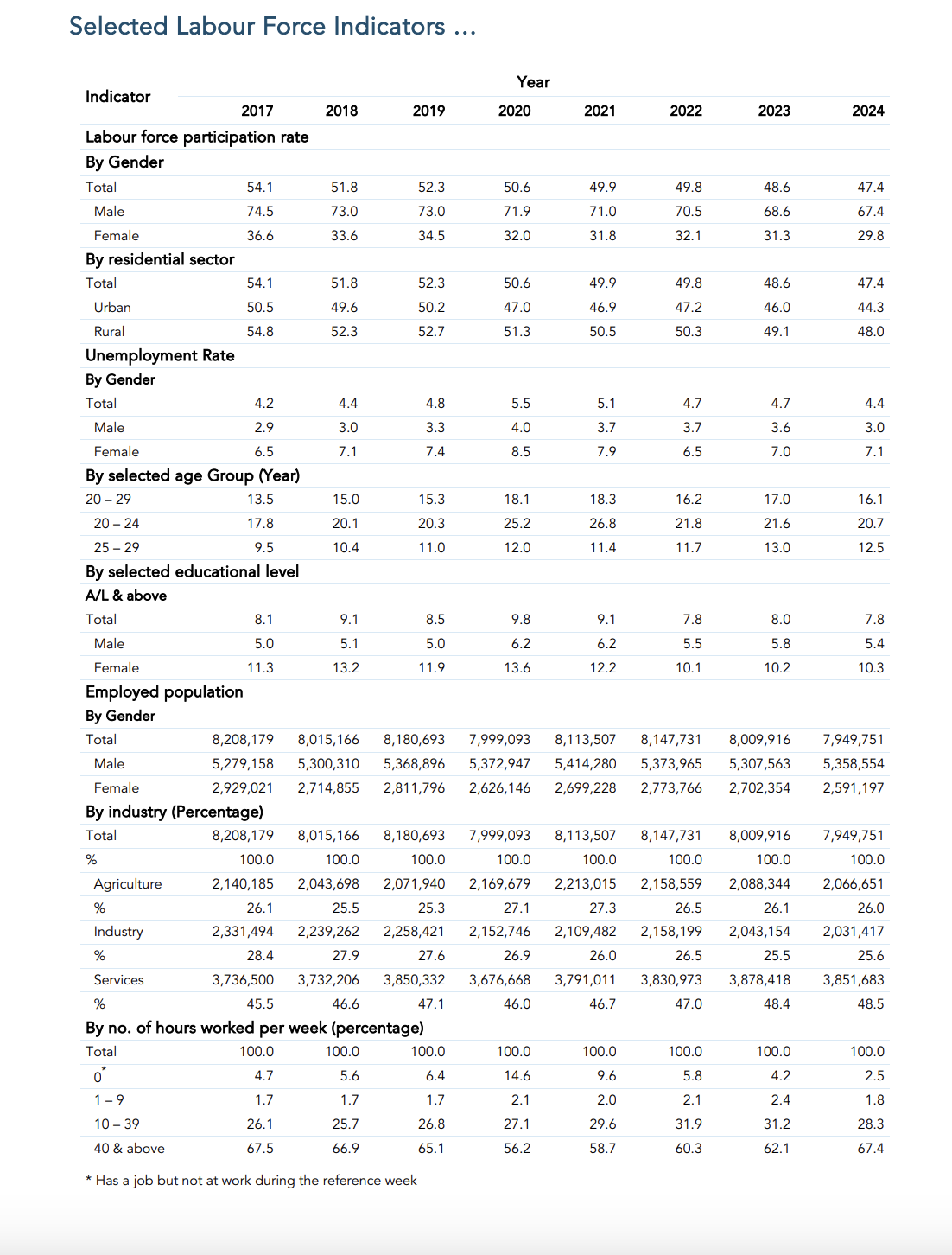
Despite modest improvements in overall unemployment, gender disparities remain significant. In 2024, Sri Lanka’s overall unemployment rate stood at 4.4%, while male unemployment was 3.0%. In contrast, female unemployment remained high at 7.1%.
The gap is particularly visible among those with A/L and above qualifications, where educated women continue to face higher unemployment rates than their male counterparts.
Youth unemployment continues to be one of Sri Lanka’s most pressing workforce challenges. The 20–24 age group recorded unemployment levels above 20%, while the 25–29 age group remained above 12% in 2024.
These figures point to ongoing school-to-work transition challenges and skills mismatches, reinforcing the need for internships, graduate programmes, and employer-led training.
By 2024, services accounted for 48.5% of total employment, while agriculture declined to around 26% and industry remained stable at approximately 25–26%.
The share of employees working 40 hours or more per week rose to 67.4% in 2024, reflecting improved economic stability.
These trends underline the need for inclusive hiring, skills alignment, and flexible workforce strategies as Sri Lanka adapts to the future of work.
Department of Census and Statistics (DCS), Sri Lanka – Labour Force Survey (2017–2024)


